
(_Part I_ (https://www.leftcom.org/en/articles/2022-08-31/capitalism-s-economic-fo…) – _Part II_ (https://www.leftcom.org/en/articles/2023-02-28/capitalism-s-economic-fo…) – _Part III_ – _Part IV_ (https://www.leftcom.org/en/articles/2024-02-07/capitalism-s-economic-fo…) – _Part V_ (https://www.leftcom.org/en/articles/2024-10-01/capitalism-s-economic-fo…) – _Part VI_ (https://www.leftcom.org/en/articles/2025-03-06/capitalism-s-economic-fo…))
== Introduction
Regular readers of _Revolutionary Perspectives_ will know that we have been republishing, with minor additions, the article “The Economic Foundations of Capitalist Decadence”. Originally published in 1974 this was one of the founding documents of the _Revolutionary Perspectives_ group which became part of the Communist Workers’ Organisation in 1975. Written half a century ago its central premises have stood the test of time, and in the first two parts we have only made light edits to the original.
However, in this part we enter the period through which, for all the turmoil and change of the last half a century, we are still living. Given that turmoil, we have naturally developed a longer perspective than that posed in the original. In fact, as early as 1976 we had already decided that the coming of the crisis and the revival of the working class resistance across the world to its consequences meant that though the question of “war or revolution” was now on the agenda, it was not necessarily in the immediate sense. The economic struggle of the 1970s (“money militancy” as we called it amongst ourselves) did not automatically give rise to a class consciousness of the need to get rid of the system, even if that system was exhibiting more and more contradictions. Our explanation of the causes of the crisis that emerged then has remained, but after half a century it would be an admission of sterility, if we did not take in subsequent events, as well as expand on those issues where we have since developed our analysis further. This, and the next part of the series, will thus be more heavily edited than the first two. This one will end in the period in which it was originally written, the end of the post-war boom. This was when the working class, faced with attacks on living standards, initially through a huge hike in inflation, responded with strikes and insurrections across the world. These led to the birth of new organisations of the Communist Left like the CWO, and the rejuvenation of already existing ones like the Internationalist Communist Party (Battaglia Comunista). For our new generation, it led us to Marx’s analysis to explain the material reality through which we were living. However, what we could not see in the early 1970s, was how the system would react both to the end of the cycle of accumulation and to the resistance of the working class to the attempt to make it pay for that crisis. The next parts of this series will summarise the articles we have written since about all the twists and turns of the subsequent capitalist response to the end of this cycle of accumulation – a cycle whose central problem, the need for massive devaluation of capital, still has not been resolved.
One other thing we have had to do over the years is define the term “decadence” against misinterpretations which suggested it meant that capitalism was bound to collapse in short order. Modes of production take centuries to rise and fall and their contradictions can lead to new developments, and sometimes even apparent expansion, before they finally fall. Even then economic contradictions alone do not end class rule. As we wrote in _Internationalist Communist_ 23:
"We are dramatically living through the decadence of capitalism, we can identify certain phenomena in which it can be seen but we obviously cannot foresee when this period will historically end. In the absence of an alternative capitalism could still carry on its mad course for centuries. The decadence of capitalism doesn’t mechanically lead to socialism. It is a methodological error to foresee the natural end of capitalism and the arrival of socialism without revolutionary action by the proletariat. Socialism isn’t the natural outcome of capitalist decadence but the fruit of the victorious struggle of the proletariat guided by its international, and internationalist, party.(1)"
Decadence is thus only a useful shorthand term to describe all the features that characterise capitalism in the era of the tendency to monopoly, imperialism and state capitalism, but the basic goad of the law of the tendency of the rate of profit to fall remains the material driving force of the cycles of accumulation which remain in place, albeit in a different form. They remain critical for understanding where we are today, which is at the end of the third cycle of accumulation of capitalism’s decadent period. This one though poses a bigger threat than ever. The journalists of the ruling class talk of a “polycrisis”, with economic stagnation, pandemics, imperialist war, environmental degradation and global warming all threatening, not just the future of capitalism but potentially the future of humanity itself. There is no guaranteed outcome. We are entering one of the periods described by Marx in the _Communist Manifesto_ where we will be faced with either the revolutionary reconstitution of society or the common ruin of us all. Knowing where we are though is only the first step. Neither revolutionary minorities nor the wider working class can wait with folded arms to see what happens. The time to get organised, both collectively and politically, is already long overdue. This series is intended as a contribution to that effort.
== The Age of Imperialism and State Capitalism
=== The Era of Capitalist Decadence
The outbreak of world war in 1914 was the decisive manifestation that capitalism was henceforward a decadent mode of production. But since we have already explained that the falling rate of profit is the basic motive force of capital accumulation, during both capitalism’s ascendancy and its decline, how are we able to assert categorically that world capitalism is now a decadent social system and has been since approximately 1914, although it has still managed to continue to accumulate and even “expand” the productive forces? Let us first emphasise that we say “approximately 1914” as the date for the beginning of capitalism’s decline. A mode of production does not suddenly become decadent overnight, and it can be argued that capitalism had fulfilled its historic task of creating the world economy and establishing the material foundations for communism some time before 1914. However, with the development of monopoly capital and the world economy, a point is reached where the strictly economic crisis of the cycle of accumulation is no longer sufficient to rejuvenate the accumulation process. Centralisation of capital has proceeded too far and there are now too few small, unproductive capitals to fall by the way side. Devaluation of capital as a result of the devastations of world-wide imperialist war is the only solution to the crisis of global capitalism.
In the previous parts of this study, we have seen how the counter-tendencies to the falling rate of profit prove to be ineffective or else lead to imperialism, and eventually world war, once capital is established as the dominant world mode of production. The rise of global capital means the end of laissez-faire or classical capitalism. The accumulation of capital after the First World War could only take place on the basis of constant and growing state intervention in each national economy and the gradual absorption of civil society by the state — hence the existence of the tendency towards state capitalism throughout the world. This, besides involving increasing state ownership and control of the means of production, fiscal policies which attempt to control the economy, also involves the stimulus of waste production (i.e. production which, from the viewpoint of global capital, cannot lead to further capital accumulation) of which the most pronounced expression has been arms production. With classical competition now subsumed under a situation of permanent inter-imperialist rivalry, the booms and busts now present themselves as world economic crises, often accompanied by growing arms production since ultimately the mammoth devaluation of capital needed to enable a new round of accumulation can only be resolved by war, itself a prelude to a new period of reconstruction. The history of capitalism since the start of the twentieth century has been the history of this cycle of crisis — war — reconstruction.
The two World Wars served as means of devaluing capital and permitted a realignment of the imperialist powers(2), but this in no way affected the relative position of the less advanced states who henceforth have been mere pawns in the manipulations of the inter-imperialist rivalry of the advanced states, since it is difficult for the so-called “developing” countries to compete on the world market independently of the imperialist powers.
From the viewpoint of the proletariat, on the other hand, the existence of global, decadent capitalism means also the existence of the material possibility of world revolution and the institution of communism as a higher mode of production. The world revolutionary wave of 1917-21, in spite of its defeat, proved that communism was no longer a utopian ideal, but a practical possibility. But more than this, the First World War proved that the continued existence of the capitalist mode of production was a “fetter” on the development of the productive forces and the institution of communism by the proletariat is essential if society is not to sink into barbarism.
=== Statification Immediately Before, During and After the First World War
We saw in the discussion of imperialism that state expenditure was increasing as a proportion of the total national income of the advanced states from about 1870 onwards. Armaments, as we saw above, comprised the largest single item of state spending, but other important items were education and public utilities (services with a high technical composition, such as gas and water supply). In 1909 the British Government indicated how far the needs of decadent capitalism were sustained by the State with the formation of British Petroleum (BP), with a government controlling share.
It was in the US however where the tendencies to monopoly of the “Gilded Age”, noted in the previous part(3), threatened not only to kill off the development of new capitals via monopoly pricing but even to distort the political process. In response to protests from organised labour, farmers in the “Granger Movement”, the founding of an Anti-Monopoly Party, the first anti-trust law, the Sherman Act, was passed in 1890. Under the _laissez-faire_ (and Social Darwinist) regime of President McKinley it remained largely unused. It was only after his assassination that his successor Theodore Roosevelt, an enthusiastic supporter of an American Empire, would apply the act to bring the likes of JP Morgan and Rockefeller to heel. It was bizarre that a government had to act “to protect competition” (which capitalist claim comes naturally to the system) but it was the beginning of a process where even today markets are regulated and even “made” by the state.(4) Roosevelt though did not go so far as to nationalise actual industries but forged a relationship with them where government contracts became the main source of national planning and capital. The seeds of the post-Second World War “military-industrial-Congressional complex” had been sown, and by that time, and in the post-war boom, industry leaders would seamlessly pass in and out government service.(5)
The outbreak of war in 1914 accelerated this development towards statification in all the leading capitalist powers with central governments taking more or less direct control over production for war purposes. In Imperial Germany after 1916, Rathenau’s control of the economy was so great that it was called “state socialism”, whilst Lloyd George, describing the men who helped run his Ministry of Munitions, said,
"... “All the means of production, distribution and exchange” were aggregately at their command.(6)"
Many specific aspects of this state intervention were revoked after the war but others remained and state capitalism as a tendency of all capitals was firmly established. The tendency towards statification of the economy is not just the result of the need for production within national states to be geared to the military requirements of war, although this need accelerates and emphasises the trend. A more important reason can be traced to the chronic lack of surplus value as a result of the cripplingly high organic composition of capital. Faced with stagnating industries (whose surplus value is too low to provide for a further increase in constant capital) the state has been forced to try and avoid collapse of the economy by adopting what had hitherto been the function of the market, i.e. promoting the formation of an average rate of profit by redistributing surplus value throughout the economy.
"In the course of capital concentration, more surplus-value comes to be divided among relatively fewer enterprises, a process by which the market loses some of its functions. When the market mechanism ceases to “square” supply and demand by way of capital expansion, it complicates the formation of an average rate of profit, which is needed to secure the simultaneous existence of all necessary industries regardless of their individual profit rates. The average rate of profit, ... implies the “pooling” of surplus value so as to satisfy the physical needs of social production which assert themselves by way of social demand. Capital stagnation, expressed as it is as defective demand, hinders an increasing number of capital entities from partaking of the social “pool” of surplus value. Control of surplus value becomes essential for the security of capitalism and the distribution of profits becomes a governmental concern.(7)"
Hence the reason for the marked increase in state control over banking, credit, etc., government subsidies and outright nationalisation of many basic industries after the First World War, particularly with the onset of the 1929 crisis. Thus, for example, the French Government lent money to nearly all its shipping lines, to civil aviation companies, to insolvent banks and nationalised the railways. The British Government:
"... achieved the amalgamation of the railways (1921), the concentration — indeed the partial nationalisation of electricity supply (1926), the creation of a government sponsored monopoly in iron and steel (1932) and a national coal cartel (1936)...(8)"
In Nazi Germany, despite Hitler’s rantings against Bolshevism, state control of the economy proceeded apace. Capitalists were organised into the “Estate of Trade and Industry”, the workers into the Labour Front, whilst in February 1938 Goering was made economic dictator in order to realise the “Four Year Plan”.
"The measures ... introduced were not the product of a specific Nazi ideology of economics. They were rather the type of scheme adopted, though with much less vigour, in many countries in the 1930’s nowadays summed up in the term ‘Keynesianism’. They were in part based on the ‘war socialism’ introduced in Germany during the First World War.(9)"
In Italy in 1933 the Fascist Government set up the Institute for Industrial Reconstruction (IRI):
"... a permanent industrial holding-company to aid the government’s programmes of autarchy and rearmament, it continued to limit its operations to industries and services in which private enterprise was willing to invest sufficient funds.(10)"
In both Italy and Germany economic recovery was based on armaments production and savage exploitation of the working class, though in fact total social output of both countries fell between 1929 and 1938.(11) We shall see below how this mechanism “aids” accumulation under decadent capitalism. However, statification (in the sense of state ownership of industry), although on the one hand assists the redistribution of surplus value and the general propping up of the economy, on the other, further reduces the profitability of the private sector, since it is mainly by directing surplus value from the latter that the state is able to finance its enterprises. The same process whereby the state attempts to equalise profit rates between industries with high rates of surplus value (which tend to be in Department II) and those with low rates of surplus value ( which tend to be in Department I) operates in fully state capitalist economies (so-called “communist” states), but here it is easier to transfer funds from one industry to another, since the state, acting as one huge entrepreneur, is in direct control of the total national capital. In all modern capitalist economies the unprofitable sectors which are maintained by the state represent an increase in the cost of production from the point of view of the economy as a whole, and thus contribute to further lowering the rate of profit.
The accelerated efforts to ‘rationalise’ production after the First World War by means of ‘scientific management’, ‘labour-saving’ devices, introduction of bonus systems, etc., were desperate attempts to offset the falling rate of profit by increasing the rate of exploitation in those industries which were still profitable. In Britain and France the decline in the standard of living of the workers is apparent by the fact that real wages fell to below the level at the beginning of the century, whilst in Germany, the “share of wages in the national economy dropped from 64% in 1932 (itself a significant drop from the 1928 level) to 57% in 1938.”(12)
Nevertheless, attempts to increase both relative and absolute surplus value helped to increase the growing numbers of the unemployed in all the advanced capitalist states, and central governments again stepped in with further nationalisations, social security schemes and public works to try and maintain production. F.D. Roosevelt’s New Deal in the United States was the most ambitious of these. New Deal measures never actually “primed the pump” of capitalist accumulation despite the propaganda claims, but socially it helped to hold the system together through the Great Depression. By 1937 it was already clear that state spending alone would not be enough to end it. Instead imperialist tensions that had mounted during this economic crisis led to more “beggar my neighbour” policies as tariffs rose and “autarky” or “imperial preference” were proclaimed as national imperatives. Rearming in the face of these tensions may have raised profit rates for armaments manufacturers but only added to the drive to all out imperialist war in 1939 and 1941. It would be this which would ultimately destroy capital values in such massive quantities that would be the signal for the start of a new round of accumulation and the longest secular boom in capitalist history after 1945.
In the USSR the isolation of the 1917 revolution to a single country produced not socialism but a different variant of state capitalism. With world revolution now seen as years away, the New Economic Policy (NEP) was adopted in 1921. Lenin was perfectly frank that it was a step backwards to “state capitalism” but he always held the illusion that state capitalism would provide a halfway house to socialism. Even the Russian Left Communists, who had denounced any attempt to establish western-style (later to be called “the mixed economy”) state capitalism in Russia, did not see that total state ownership of the productive forces did not equal socialism (although Engels had warned of that). Throughout the 1920s the debate in the USSR was about what direction to take in accumulating capital. Bukharin emerged as the defender of continuing NEP (and building up agriculture first by concessions to the peasantry) whilst his former Left Communist colleague, Preobrazhensky, called for more rapid industrialisation (a policy supported by Trotsky). These “super-industrialisers” of the Left Opposition were defeated by Stalin through his control of the Party apparatus but that did not stop him stealing their policy in 1928. This was not, as Stalinists and most Trotskyists have maintained ever after, the start of the drive to socialism, but was in fact the initiation of another model of state capitalism. It was one which would later carry out a lot of appeal for states which had been under the yoke of colonialism and sought a way to accumulate without having to rely on the capital investments of their former imperial masters, especially after the Second World War. Stalin made it quite clear that the motive for the Five Year Plans was not to create a better life for Russian workers (whose exploitation would provide the surplus value for these plans) but to create a military machine which would be able to resist the attacks of the Western powers which, even in 1928, he was convinced were preparing to attack the USSR. It was, as the Nazis were to say a little later, “guns not butter”. During the 1930s though, when mass unemployment was ravaging the Western economies after the Wall St Crash, the Five Year Plans gave the impression that a fully planned command economy (wrongly dubbed “socialism” in the USSR and “communism” in the West) was superior to the traditional capitalist economies. Alongside of a strike wave and housing occupations in the immediate post-war period, it was to play some part in the adoption of welfare and social security measures in the so-called “free world” as the economic and ideological competition between the two dominant powers after the Second World War developed into the Cold War.
=== The Post-War Boom
Thus after the Second World War there was no relaxation of wartime control of the economy as had happened after the First World War. In fact, state capitalist tendencies became more and more emphatic. State expenditure as a percentage of GNP grew dramatically. (See the state expenditures and public debts table below). In the USSR, the fourth Five Year Plan was inaugurated in 1946; France adopted the “Monnet” Plan and nationalised Renault, coal, gas, electricity, the bank of France, the large commercial banks, Air France, and the largest insurance companies, whilst Britain’s list is no less extensive. Whilst state capitalism in the US has, as we have already noted, largely taken the form of government defence contracts, German, Italian and Japanese recovery in the post-war period of reconstruction was initiated by Marshall Aid from the US and maintained by making use of pre-war state control. In Italy, IRI (see above) grew enormously, producing 60% of the country’s steel, owning Alfa Romeo and employing 200,000 engineering workers, besides controlling most public utilities and works; whilst in West Germany,
"Far more than in any other capitalist country during this period the bourgeoisie ... made use of the state apparatus, and the monetary and fiscal system to force capital accumulation...(13)"
This growth of state capitalism meant that even in the supposedly free enterprise West, the public sector now universally emerged as incomparably the largest employer. (See the public sector employees table below). It should be noted that direct government control was largely in the basic industries which require a high mass of profits to maintain capital renewal and accumulation. The fact that the state was forced to take them over is indicative of the historic crisis itself where the tendency towards equalisation of the rate of profit was breaking down. This explains why the trend towards nationalisation initially intensified further when the post-war boom ended at the beginning of the 1970s. With the state controlling UCS and Rolls Royce, and further statification in the form of the National Enterprise Board, and the nationalisation of British Leyland and the shipbuilding industries imminent, Britain led the way in this universal development.
http://www.leftcom.org/files/public-sector-employees.jpg

=== Inflation as a Permanent Feature of Decadent Capitalism
A large part of government spending which accompanies statification of the economy is in fact unproductive — i.e. expenditure which does not lead to a further accumulation of capital. The whole of the tertiary sector (social services, etc.) as well as arms production (see the following section) can be subsumed under the same heading of unproductive expenditure. Nevertheless, this increase in unproductive spending does not in itself lead to inflation (i.e. to rising prices). If we remember that at the level of the economy as a whole, total prices tend to equal total values, then it is clear that from the point of view of total social capital, such spending represents a drain on the ‘pool’ of surplus value and hence contributes to a further lowering of the rate of profit. Inflation, however is the result of an expansion of the money supply without a corresponding increase in the amount of value produced.
In other words, rising prices, which mean no more than the fact that a larger amount of currency must be exchanged to purchase any single commodity, are a reflection of the devaluation of money as it seeks to re-establish its own real value in the face of an expanding supply of money. The consequences of an increase in the money supply without a corresponding increase in the creation of value can be illustrated in terms of bourgeois classical economic theory, where M = volume of money, V = velocity of circulation, P = prices and T = output, and where, under equilibrium conditions, MV = PT. Clearly, any increase in M without an equivalent increase in T would lead to P (i.e. prices) rising. Unproductive expenditure as such does enter into the equation. The key factor in an inflationary situation is the expansion of the money supply at a rate faster than the increase in production of new value (or “output” in classical terms). Thus, no matter how unproductive capitalism was, there would not be inflation if there was no expansion of the money supply. There would, however, be a very big crisis of unemployment.
In the post-war period the state has been increasingly forced to resort to expanding the money supply partly in order to avoid direct attacks on the wages of the proletariat and attack them indirectly by undermining real purchasing power. Although direct attacks have been, and still are, an important source of government revenue, they are unable to provide the full amount of revenue necessary for the growing number of state responsibilities and deficit financing (i.e. a situation where the state spends more money than it receives from taxation) has been a common feature of all “mixed” economies since the First World War and particularly after the early 1930s when the gold standard was finally abandoned.
In order for the state to be able to control the supply of money it is necessary for each national economy to be free from the constraints of a metallic conversion standard. Throughout the nineteenth century the money supply of national economies had been closely tied to the amount of actual gold or silver (bullion) held within the state boundaries. Paper notes issued were legally convertible into metal coinage and the extent to which notes could be issued was limited by the obligation to ‘back’ paper money with metal coinage held in banks and convertible at a fixed legal rate. Thus the supply of money was limited by the stock of bullion held by the banks within each national state. The outbreak of the First World War saw the abandonment of the international gold standard as the belligerent states met the gigantic costs of financing the war largely by the simple method of printing money. Thus, by 1918, increases in the issues of paper money in Germany were five times the 1914 figure, in Britain, four and a half times the pre-war figure, and in France, almost four times the 1914 sum. Since this increased supply of money was financing the waste production of war and not leading to the production of new capital, prices soared — 245% in Germany, 230% in Britain and 353% in France.(14) The devaluation of currency which accompanied the abolition of the gold standard within the various national states provided a short-term increase in competitiveness for the commodities of the devaluing country sold on the world market, as prices were lowered in relation to commodities from other states. Such an effect could only be temporary, since it only encouraged competing states to go off the gold standard and devalue their currency. By 1936 all those ‘gold bloc’ countries which had previously tried to maintain the gold standard had abandoned it and devalued their currencies.
In the 1930s, just as during the First World War, going off the gold standard enabled central governments of the advanced capitalist states to increase the money supply and further expand their intervention in the economy. As we shall see below, the greatest increase in government spending was due to the massive increase in arms production, but the fear of “political unrest” by the proletariat in a situation of mass unemployment also led the state to extend existing welfare services and engage in the construction of public works.
http://www.leftcom.org/files/state-expenditures.jpg
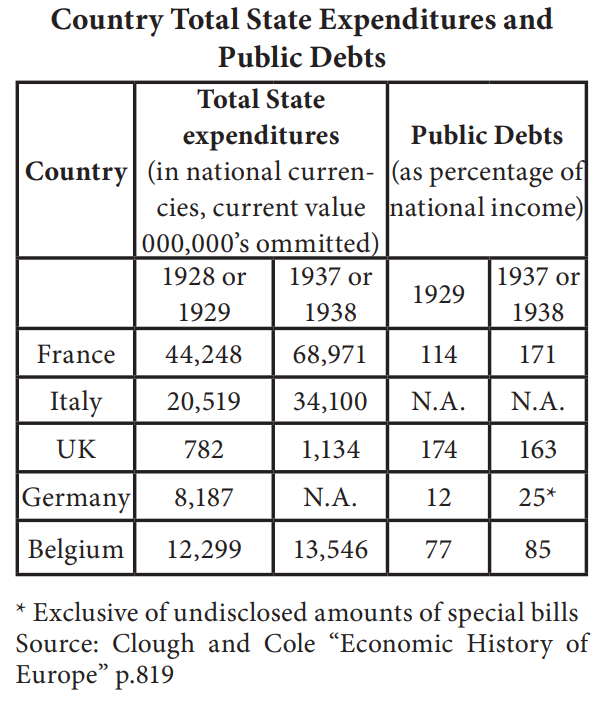
This huge increase in waste production which was largely financed by deficit spending could only lead to increasing inflation and a growth in the public debt, as evidenced by the table above.
The tremendous cost of financing the Second World War was again met largely by central governments borrowing from banks in return for government bonds or treasury bills, thereby expanding the money supply. The table below clearly shows the increase in note circulation during the Second World War. This huge increase in the money supply in order to finance the war led to rampant inflation in all the belligerent states towards the end and immediately after the war as measures to fix prices became ineffective. The policies adopted to overcome inflation again could only be temporary solutions to the problem.
http://www.leftcom.org/files/note-circulation.jpg

In the West the implementation of Keynesian measures saw the more or less conscious extension of policies which the state had been forced to adopt since the First World War. Keynes thought that the periodic crises of capitalism could be averted by manipulation of interest rates to encourage investment and by means of deficit spending and public works to maintain employment during times of depression — the resultant increase in the national debt would be repaid during the ‘boom’ period. In fact what has occurred is a permanent increase in the national debt of all the advanced states and inflation has proved to be a permanent feature of decadent capitalism. For instance,
"Prices in Western Europe rose by 66 per cent between 1947 and 1957. This was a compound rate of increase of more than 5 per cent per year, a rate roughly equal to the yield of government bonds (before taxes).(15)"
According to Keynesian theory, gradual inflation is a healthy rather than an unhealthy feature of national economies, since it encourages businessmen to invest and increases the competitiveness of exports on the world market. Nevertheless, if we remember the reason for the existence of inflation in the first place (expansion of the money supply at a faster rate than the production of new value), then it is obvious that inflation must become more than a ‘gradual’ process if the rate of expansion of the money supply continues to outstrip the rate of value production. As we shall see, this was the case in the 1970s, with the development of a world-wide “recession” which brought to an end the long boom of the “thirty glorious years” as it is dubbed by French bourgeois economists.
=== Imperialism and Underdevelopment
To Keynes the Second World War proved that any economic system could have full employment if it so wished and he was frightened that the end of the war would only bring back unemployment on the scale of the 1930s. However, in the immediate term he need not have worried. The massive destruction of the productive forces during the Second World War provided a new basis for economic recovery.
"Throughout Europe railroad lines, marshalling yards, and port facilities lay in ruins. Machinery